
Interview by Anna Louise Jones — Photos courtesy of Raunie Mae
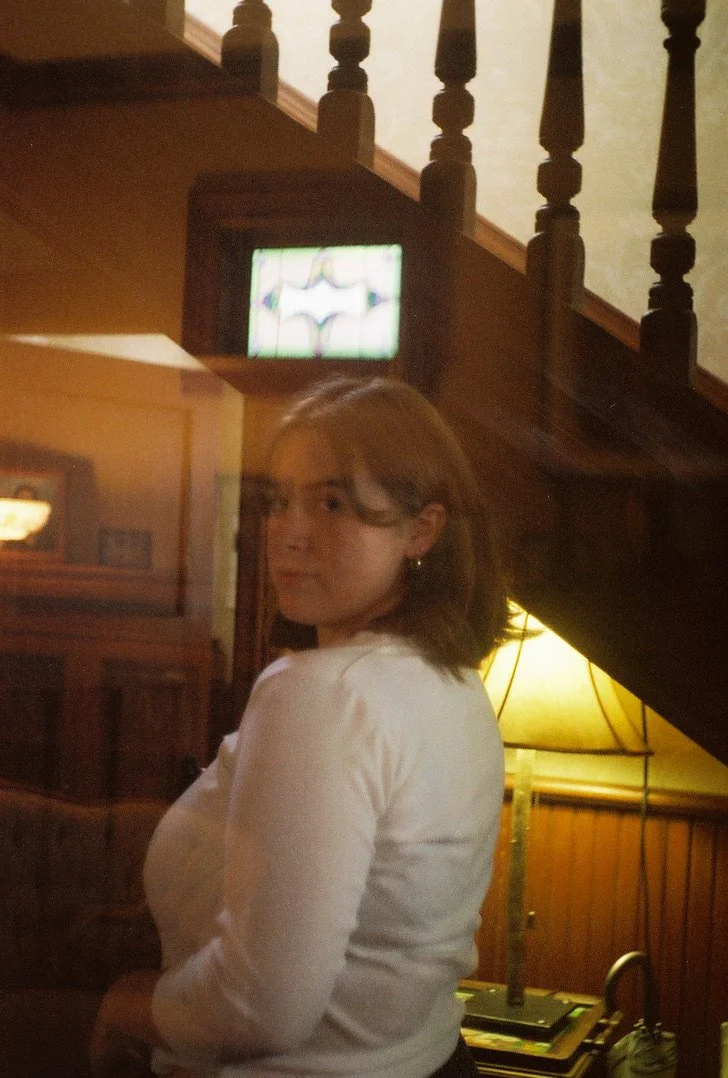
Marie Dresselhuis has been thinking quite a lot about the things we're slowly making less time for. Reading books, going for walks, making music with friends, sitting with uncomfortable feelings rather than immediately looking for a way around them. They're fairly ordinary things, really, but perhaps that's precisely the point. In a world increasingly concerned with making everything faster, easier and more efficient, Dresselhuis is becoming rather attached to the idea of doing things the long way. Her latest release, 'Leave the Music', is a fairly direct response to the growing presence of artificial intelligence in music, but the conversation surrounding it quickly becomes something much bigger. It's about creativity, connection and what happens when we start outsourcing the very things that make us human. Recorded alongside friends in the cramped living room of an Airbnb, the song is also something of a practical demonstration of her beliefs. A little messy, a little unpredictable, and all the better for it.
Raised in Vancouver in a family where music was never particularly far away, Dresselhuis has spent much of her life surrounded by it. Classically trained on piano, she eventually found her way to guitar as a teenager, developing a relationship with songwriting that seems to have become increasingly important as she's grown older. But while music has always been a constant, her understanding of what it means to make it is beginning to shift. The idea for 'Leave the Music' came around this time last year, when she started noticing AI-generated artists accumulating millions of streams and appearing on the Billboard charts. "It's bleak," she reflects. It's a fairly understated reaction to something she clearly feels much more strongly about. Dresselhuis is particularly unconvinced by the suggestion that there is necessarily a middle ground to be negotiated when it comes to AI and artistic creation. Whether it's generating songs, writing lyrics, creating artwork or even outsourcing the smaller decisions involved in a creative career, she struggles to see where the distinction should be drawn. For her, the issue extends beyond the technology itself and into a much wider question about how willing we've become to relinquish our own creative instincts. "We've gone so far without needing this. We have brains; we don't need to outsource our thinking and our creation," she says.
It's an argument she makes with considerable conviction, although what makes it particularly interesting is how often she brings it back to the ordinary. Dresselhuis is concerned about the gradual erosion of our ability to think critically, engage with the world and, perhaps most importantly, sit with ourselves without immediately reaching for something to fill the silence. There's a frustration with the assumption that people don't actually enjoy doing difficult things, that a better life is one in which we're relieved of as many responsibilities as possible. She points to the countless people who continue making music despite the financial uncertainty, long hours and often exhausting nature of trying to sustain a creative career. If people genuinely disliked the process, why would they keep doing it? "I want to live a life where I insist on holding on to what it is that makes human beings inefficient," she explains. It's a rather lovely way of putting it, particularly as she starts talking about the less quantifiable parts of being alive: sitting with someone through grief, holding a friend's hand for half an hour, revisiting difficult feelings or simply allowing yourself to experience something without immediately looking for a productive outcome. “There's nothing efficient about how we feel, and experience and live, and enjoy”, Dresselhuis continues. There's a certain way in which she speaks about the subject of being human, a passionate tone you can’t quite put on paper.
That philosophy has found its way into the recording of 'Leave the Music', too. Having previously spent considerable time recording individual parts separately, often returning to her vocals to comp and tune them until they reach a level of polish that can sometimes feel disconnected from the original performance, Dresselhuis has become increasingly interested in allowing a little more room for imperfection. This time, she and a few friends gathered in an Airbnb living room and played together, embracing the inevitable noise and unpredictability that comes with having several musicians occupying the same space. There was microphone bleed, unexpected sounds and the sort of spontaneous energy that can be difficult to recreate when every part is recorded separately. Rather than trying to iron everything out, she wanted to keep it. She's also been making a conscious effort to become less concerned with perfectly tuned vocals, questioning why she's spent so much time assuming that everything needs to sound immaculate. It's not that she objects to polished production, or even to vocal tuning as an artistic choice. She's simply beginning to recognise how much of her desire for perfection has come from an expectation rather than an actual creative preference. "Perfect doesn't really exist," she says. And perhaps it's worth remembering that a song doesn't suddenly stop being alive once it's released. In an industry where a track can arrive at midnight on a Friday and seemingly have its most important moment within the first few hours, there's an enormous amount of pressure placed on that one finished recording. Dresselhuis is interested in something a little more enduring: the idea that music continues to evolve as it finds its way into other people's lives.
For someone who feels so strongly about the importance of human creativity, it's perhaps unsurprising that Dresselhuis is also beginning to reconsider the kind of career she wants to build. There's an interesting tension between her desire to share music with people and her growing discomfort with the systems through which artists are expected to reach them. Much of the contemporary music industry relies on a constant online presence, with musicians increasingly expected to turn their everyday lives into an extension of their promotional output. It's a strange arrangement when you consider that an artist's ability to find an audience can become dependent on other people being just as chronically online as they are. Dresselhuis admits she's been thinking quite seriously about what an alternative might look like, and her answer is refreshingly uncomplicated. She'd be perfectly happy being a piano teacher and hosting open mics rather than spending years maintaining an online presence in the hope of eventually selling out an arena. It's not that she doesn't want people to hear her music, or that she's unwilling to put in the work required to build a following (her 80k+ followers across Instagram and Tiktok can surely attest to this). Rather, she's beginning to question whether the version of success she's been encouraged to pursue is necessarily one that would make her happy.
In many ways, the alternative she's imagining already exists in the little pockets of community she's been discovering around Vancouver. Dresselhuis has a particular fondness for the city's public library, which has an entire floor dedicated to music scores and manuscripts. She describes the pleasure of taking out a Tchaikovsky score, putting on the corresponding symphony and following along as the music unfolds on the page. It's a small detail, but one that says a lot about her relationship with art: the desire to explore something physically, to spend time with it and discover something you might otherwise have overlooked. She's also recently stumbled across a community centre and art gallery just a short walk from her home, tucked away in a wooded area and subsidised by the city, making it surprisingly affordable to rent. Alongside a friend, she's begun organising open mics there, with ambitions to host more community events and even dances. She'd also love to take her music into less conventional spaces, particularly libraries and record shops; there’s something wonderful about that. It's hardly the usual route to musical stardom; perhaps that's exactly why it appeals to her. Rather than waiting for an audience to find her online, Dresselhuis is interested in creating the spaces where people might find each other instead.
Dresselhuis’ objections to AI aren't rooted in a romanticised belief that everything was better before technology arrived, but in a concern that we've started to mistake convenience for fulfilment. She talks about waking up in the morning and immediately reaching for her phone and laptop, already feeling the pressure of the emails she needs to send and the work she needs to get through. Recently, she had to actively force herself to do something different. To go for a walk, read a book by the fire and have some tea. What struck her wasn't simply how difficult it had been to make that decision, but the almost frightening feeling of unproductivity that accompanied it. Dresselhuis likens the pressure to constantly be building towards something to a tree, where the visible growth of the trunk receives all the attention while the roots, the less immediately impressive part, are quietly doing the work that makes everything else possible. She laughs at herself for the slightly unusual metaphor, but it's an interesting way of looking at the problem. There's little point in building something impressive if you've forgotten what sustains it. She doesn't necessarily believe that AI usage is something we can address through individual decisions alone, particularly when its presence in daily life is becoming ever more difficult to avoid. She's increasingly concerned with how difficult it seems to have become to choose the slower, more intentional option, even when it's something we know we value. She talks about wanting to walk to her local library rather than simply ordering a book online, and wonders whether we might do better to hold each other accountable to these small acts of resistance. "Can we walk alongside each other to keep each other accountable to go to the libraries, and to boycott the things that we want to boycott? Because we can't do this by ourselves," she asks. For Dresselhuis, perhaps part of the answer lies in being a little more deliberate about the choices we make collectively, and in creating communities that encourage us to question what we're so readily willing to outsource.
For all her anxieties about the direction things are heading, Dresselhuis hasn't lost her faith in people. If anything, she seems particularly determined to hold on to it. She speaks enthusiastically about the friends around her who are continuing to make things from scratch, building visual worlds around their music and putting genuine care into the creative process. She's also convinced that audiences still want something technology can't quite manufacture, saying “people want to go to shows where the person is on the stage and not being a perfect performer, and people want to go to shows and feel kind of tired from standing up the whole time and looking around and seeing people crying”. She wants to hear people's voices, even if they're uncertain of their abilities. She wants to hear someone singing in front of an audience for the first time, whose voice might shake with nerves, or someone discovering the particular magic of singing alongside a choir. There's a history behind those voices, a collection of experiences that makes them worth listening to. It's a sentiment that feels particularly fitting for someone who grew up making music alongside other people.
Music, for Dresselhuis, has never been entirely about the final sound; it's about the people who make it, the circumstances that bring them together and the things they carry into the room. That's likely also why she's so interested in the idea of music as something that continues to exist beyond the moment of its creation. “Most native languages don't even really have a word for music, because they see it as less so, this like, specific point or thing in time or space, but as this like inevitable ever-unfolding process”, she tells me, looking out of the window towards some trees. It's a rather different way of thinking about music in an industry that increasingly asks artists to package themselves and their work into neat, immediately consumable moments. Yet there's something hopeful about the possibility that a song might continue to change, that its meaning might shift depending on who's listening and what they're going through. Dresselhuis admits that it's sometimes difficult to hold on to this belief, particularly when the wider world can feel so overwhelming, but she ultimately returns to the idea that creating something is an act of hope in itself. Even if something lasts for only 40 seconds, that doesn't necessarily make it insignificant.
By the time our conversation comes to an end, it's clear that Dresselhuis's objections to the future of music are really rooted in an affection for everything that makes it worthwhile in the first place. It's found in the library down the road, in a room full of friends making music together, in the community centre hidden among the trees and in the decision to put your phone down long enough to notice the world around you. She's not suggesting that making music should be easy, or that technology can simply be wished away. Rather, she's interested in remembering why we wanted to make things in the first place. The ambition, the mistakes, the uncertainty, the time spent doing something that might never amount to anything particularly measurable. Perhaps the most radical thing an artist can do right now is insist that these things still matter. Marie Dresselhuis certainly seems determined to make that case, one imperfect song, one open mic and one very necessary walk at a time.
