
Interview by Anna Louise Jones — Photo courtesy of Bella Treadwell
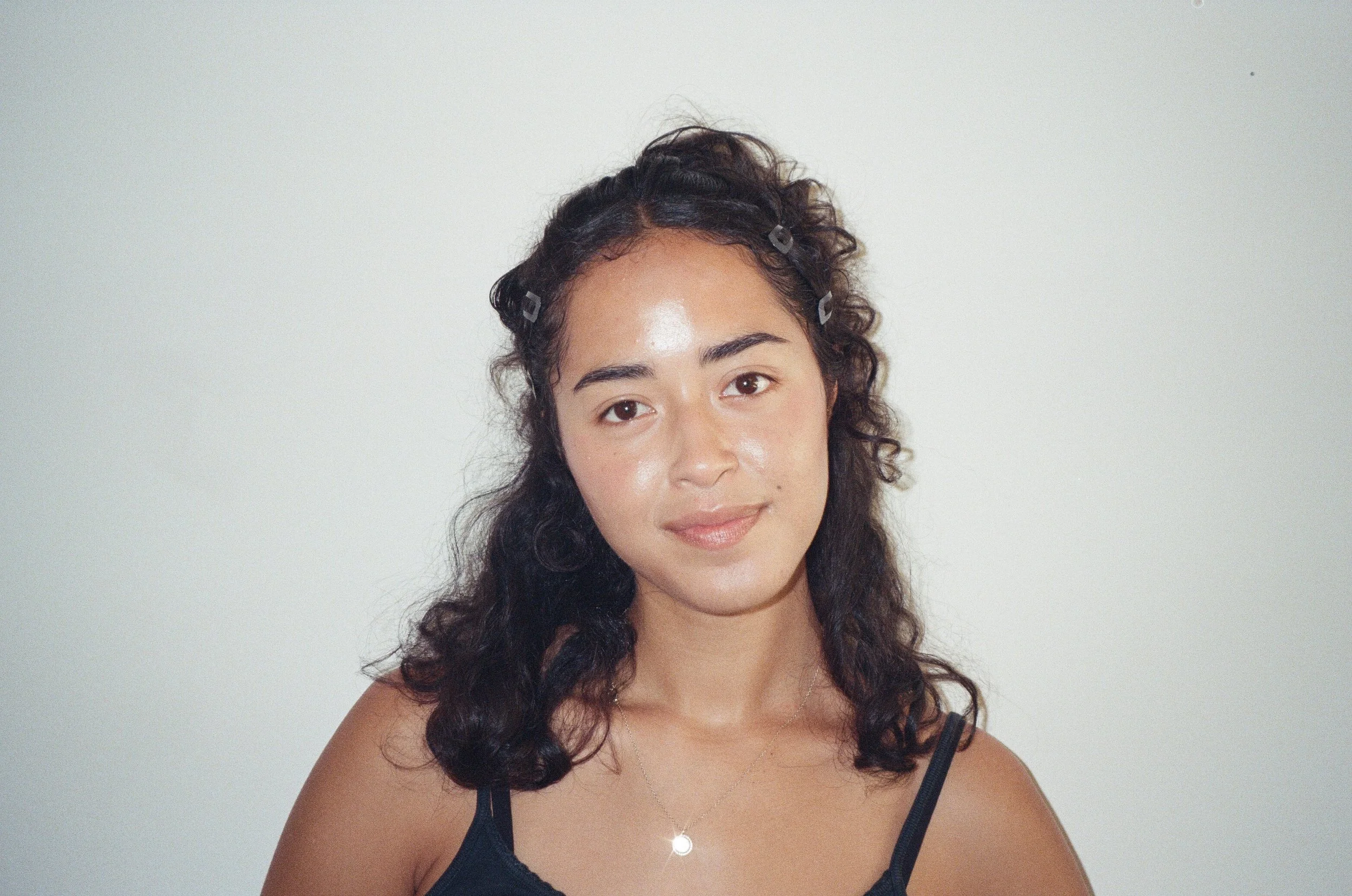
Lauren Juzang is a superstar. You might not know that just yet, but you’ll likely hear it soon. Juzang's artistry has something magnetic about it, a quirky online presence and diaristic lyricism that can both comfort the listener and punch them in the gut. Her socials feel like an extension of her personality - self-aware, funny, never taking herself too seriously. Then there’s the music, a genre-bending, soft, folky, indie-pop sound that feels distinctly her own. Intimate, but not overly delicate. Fun, but equally comforting.
Juzang joins the call just in time; she’s back in her childhood home after recently graduating from university. She relocates to her bathroom floor, trying to dim the sound of her dogs barking in another room. At the age of twelve, she thought that to be an artist, you’d be discovered on the street and somebody would make you famous. “Now I’ve learnt that it takes a lot of time, a lot of patience, and consistency”, she reflects, noting how she's now aware of how long artists like Sabrina Carpenter have been grinding to get to where they are; when she was younger, she would’ve just assumed that Carpenter had popped up out of nowhere. It speaks a lot to the media we were fed growing up: TV shows and movies like Camp Rock and Victorious showing musicians getting discovered in schools, at camp, on the streets. She jokes, saying she always thought she’d go to the non-existent Hollywood Arts. Juzang went to college to study music business; she was nervous to start professionally presenting herself as an artist, which, when you look at all she’s achieved thus far, may come as a shock to some people. The fear wasn't that she’d be told she wasn’t ‘good enough’, but that she’d be perceived as strange for even trying. Eventually, she realised nobody thought she was weird when she switched from the music business to artistry, and more importantly, nobody was particularly bothered by it - people supported her dreams. “It's been like a self-confidence exercise,” Juzang admits.
There’s something refreshingly down-to-earth about the way Juzang talks about that transformative time. Becoming an artist, for her, hasn’t been some grand declaration of ‘this is who I am now’, but a series of smaller exercises in convincing herself that she’s allowed to take up the space. Even telling parents’ friends that she’s an artist feels strange, particularly when the inevitable question is whether she actually makes money from it. She recalls getting a facial from a woman whose son is in a successful band, only for the conversation to turn to the fact that people still ask her whether he makes money from his music. It’s a funny story, LA is a funny place, but it also increasingly gets to the heart of something Juzang seems increasingly comfortable with - there is a huge middle ground between being a struggling musician and being the likes of Taylor Swift. It’s the middle ground that isn’t spoken about often. The middle ground matters to her. There’s an awareness that making a living from music doesn't necessarily mean private jets and sold-out stadiums around the world; sometimes it just means paying your bills by doing something you love. For a lot of artists today, this is the goal.
If there’s one thing that makes Juzang easy to root for, it’s that this growing confidence hasn’t erased the slightly chaotic and deeply unserious person underneath. Juzang offers three pieces of essential information about herself: she recently learnt how to juggle, she’s vegan, and she’s six feet tall. “That’s pretty important,” she adds of the latter, having achieved something most men wish they could. That same sense of playfulness has found its way into her relationship with social media, admitting that she used to worry about Instagram posts a lot more than she does now. These days, she sees the platform as her “playground”, with her stories being an extension of her actual thoughts rather than a curated artist persona. It’s clearly working, and she says she often gets comments about her online presence, specifically highlighting how funny her stories are. While most know Juzang’s sound as a soft indie-pop and singer-songwriter world, Superstar refuses to stay entirely there. One of the album’s biggest left turns is “Hometown”, a “four-on-the-floor pop track” that puts her voice somewhere a little less expected. It’s a direction that came naturally from her collaborators Aidan Spiro and Jason Vance Harris, partly because, despite the folkier sounds surrounding the project, Juzang herself actually listens to a lot of pop. She cites Justin Bieber as a particular favourite growing up, making the pop detour feel less like a calculated genre experiment and more of an honest reflection of what she likes. There’s a similar attention to detail in the way she talks about production; recently she’s become particularly fixated on drums. Having played only a small handful of shows with a full band, she’s realised just how much rhythm can change the energy of a set. It doesn’t necessarily need to mean huge, explosive drums; even something subtle can keep a song moving and, importantly, translate better to a live setting. It’s another sign that Juzang is thinking beyond simply making songs that sound good in headphones. She’s beginning to picture what these songs might become once they leave the studio, and who they might connect with.
If each song on Superstar were a person at a party, she reckons ‘Smooth Talker’ [out now] would be the one dancing in the middle of the room, while “You’re The Only One Who Knows Me” would probably be hiding in the corner. The latter is about insecurity, accepting love and learning to believe that someone might genuinely want you around. It’s rooted in a particularly vulnerable period of Juzang’s life, when a terrible facial rash left her reluctant to leave the house for months. What could easily have become a miserable memory instead became an unexpected lesson in friendship: figuring out who she felt comfortable enough around to show up as herself, without trying to hide. That same idea of insecurity, and learning to sit with it rather than run away from it, runs deeper through the album. Juzang has spent years searching for things to write about away from the typical romantic narratives; she wants to offer a sense of belonging and acceptance in her music for people who may not necessarily have a lot of experience in that department. It's not because she doesn’t love a love song, but because she’s interested in the less immediately obvious feelings that sit underneath growing up: feeling like you’re not where you thought you’d be, chasing something without knowing whether you’ll get there, and trying to make peace with the person you are while you’re still becoming them. She reflects, “It’s something I've felt for a long time and didn’t really know how to embrace, in a way”. It makes Superstar sound less like a declaration that Juzang has finally arrived, and more like a document of the process of getting there. The title might suggest flashing lights and an overnight rise to fame, but the reality she describes is considerably more human. It’s patience, awkwardness, insecurity, friendship, hard work, and, occasionally, hiding on the bathroom floor because your dogs won’t stop barking.
Even her dream live show feels distinctly Juzang. Ideally, she’d like to spend less time standing behind an instrument and more time actually moving around the stage, but not necessarily dancing, because she’s very clear that she isn’t a dancer, but being silly, doing weird things and figuring out what it feels like to perform without being anchored to a piano or a guitar. Her fantasy band is similarly ambitious, packed with the friends and collaborators she already loves working with. The only problem is finding a budget big enough to bring them all along. And if we’re dreaming properly, the venue would be the Greek Theatre in Los Angeles - an outdoor amphitheatre, big enough to feel cinematic, but still intimate enough to retain some of that Juzang warmth. Perhaps the clearest sign of Juzang’s changing relationship with confidence comes from touring. Juzang says she feels like a much better singer because of it, and more confident in her abilities generally. At one show, someone came up to her after the set and told her, very directly, that her performance was good before calling her out on her tendency to respond to compliments with a bashful “oh, stop”. It stuck with her. Not because she secretly doubted her ability, but because it made her realise she didn’t always have to shrink away from praise.
“I can be confident and normal,” she says. It’s a small revelation, but one that feels central to where Juzang is now. She can be confident without becoming someone else. She can take her music seriously while still making jokes about juggling. She can dream about the Greek Theatre while admitting she’d probably spend her first superstar pay cheque taking her friends to dinner and buying an absurdly expensive skincare treatment. She can want to be taken seriously without sanding off the personality that made people care in the first place.
If Juzang really is on her way to becoming a superstar, then perhaps that’s the most exciting part of it. Not the fame, or the money, or even the Greek Theatre, but the fact that she seems to be figuring out how to become one on her own terms. Superstar sounds like the beginning of that story, and judging by the person making it, it probably won’t be a particularly predictable one.
