
ÊMIA on Embracing the Complex
Interview by Amanda La
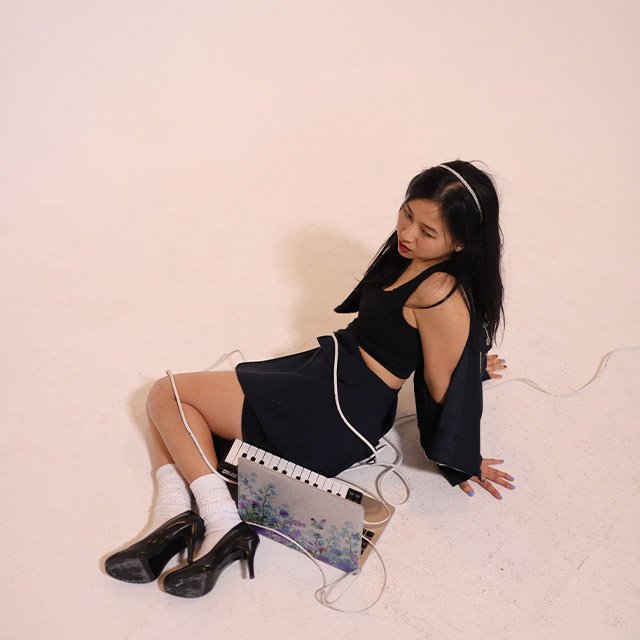
Anh Le, better known as ÊMIA, has been steadily making a name for herself by supporting artists on tour, performing with Sophie Ellis Bextor on "Dick Clark's New Year's Rockin' Eve," and getting featured on Netflix’s “Ronny Chieng Takes Chinatown.” Amidst her busy schedule, Le still made time to talk with Sound Stage about her newest single, “Corinne,” track 3 of her upcoming debut album.
SOUND STAGE: Something that I’m intrigued by is your stage name, ÊMIA. It's such an interesting choice. Is there a story you’d like to share about how you chose it?
ÊMIA: I’ve always wanted to create my own name of sorts. When I was first thinking about putting out pop and electronic music, I knew I wanted to reference the Vietnamese language while keeping some part of it connected to my real name.
The little symbol on top of the E (Ê) is the same one that's in my last name. “Em” is the she/her pronoun and also a term of endearment in Vietnamese. So when you call someone “em,” it's like calling someone babe or honey. There's this feminine aspect that I really loved about it. And the “ia” is something that I just threw at the end to make sure the name kept its femininity.
SOUND STAGE: That's really sweet, especially the connection to your cultural roots. On your website, you described yourself as “an ordinary person who decided I deserve to be seen.” How exactly do you want to be seen?
ÊMIA: I think part of my choice to make music and be an artist is somewhat a rebellious act. Deep down, I'm just really insecure and always looking for some sort of outside validation. It's almost like this push and pull between myself, of knowing that I feel this type of way, of knowing that I am pretty terrified of being seen, but also feeling like if I just create and put stuff out there, then it’s almost like tricking myself to be less afraid of that.
After years of putting my work out, I have realized that people connect most with the normal, human parts of me, even the ones I am scared to acknowledge or articulate. I want to be seen for those parts. Creating art is how I learn to love them, and I want people to witness that process.
SOUND STAGE: It sort of sounds like you're expressing that there are certain universal feelings people are terrified to acknowledge, and you want them to be able to work through those feelings as they listen to your music.
ÊMIA: The best part about being a human is ordinary life. The small things we take for granted are what makes the human experience so beautiful, tragic, and once in a lifetime. I'm trying to preserve those moments within myself, and I guess in a way, it's my own thesis statement to the world that my small heartbreak, day to day experiences, and feelings throughout life are worth something. I'm trying to convince myself and maybe convince other people too.
SOUND STAGE: When I was watching your music video for Corinne, I thought the choice of having the storyline told from the perspective of a server was so beautiful. It’s something so ordinary that people don’t even think to truly capture it. It’s not shown often or romanticized at all. I wanted to ask you how you came up with that plot for the music video.
ÊMIA: Thank you, by the way, I appreciate that. I love that video so much. I was, and maybe sometime in the future, will be catering again. Two or three years ago, I started catering on and off with one of my best friends, who kind of got me into the job because I was struggling a lot financially.
Working those shifts, sometimes there would be these parties where I feel like it was the closest I've ever gotten to experiencing and witnessing wealth in a way that I've only ever seen in movies. But I'm not like the main character…I'm just collecting coats. I feel like I'm in the middle of something kind of beautiful, but kind of also really exhausting and terrible at the same time. What really got me through those times were those side conversations I would have with other servers, and it's the classic [case where] everyone I met working this job is so talented. I think just remembering how it felt to be an observer and seeing these people cheering their billion-dollar business deal, and both feeling like ‘God, if only we were them,’ but also knowing that switching wouldn't make me happier.
I think also the job in and of itself is so performative. For some of the bigger parties, we would have these mini rehearsals of how to set down the plates and everything. Just observing it, I was like ‘Wow, this is so beautiful… to craft this dining experience where it's literally like a little play.’ And I clocked it in my head that I want to do a video that looks like this.
SOUND STAGE: I really appreciate how the music video adds a layer to the song. I kept thinking back to other songs where the title is a girl's name, and you would normally expect the song to be about jealousy over another girl, but the music video transforms it. It's not just about romantic envy anymore, but how jealousy could be targeted towards anyone you're observing and wanting to encapsulate their life.
ÊMIA: 100%. I know a girl’s name as the title evokes a lot; some of the best songs ever are named after other women, “Jolene” and recently, “Madeline” by Lily Allen. Competition and comparison is a tale as old as time, and I'm not gonna lie, a lot of the wounds in Corinne are based on a difficult romantic narrative too. But, I think the part of it that will last forever and is so universal is that sometimes you just look at someone and they just reflect everything that you don't have, and it's hard not to be like, ‘they must be more valuable than me.’ When you’re a kid, a lot of movies and TV shows about the pain of being a girl make it seem like there’s always another girl who’s clearly the villain, the obvious “mean girl.” But the worst part is that she’s never actually a mean girl at all. She's actually marvelous, and that sucks.
SOUND STAGE: The song is such a vulnerable one, and you’ve mentioned before that a lot of your music is like diary thoughts. How do you push yourself to release those songs?
ÊMIA: It helps to have friends to enable that. When I was playing this song to a bunch of my closest friends, they had a visceral reaction, which was very validating. Everyone was like ‘Oh my god, you have to put this out!’
But I also feel that if not in music, then where? Where would be the best place to put this feeling? That's what music is for, that's what art is for. I don't live my life on a day-to-day basis, constantly talking about how sad I am that I'm not some other girl. It exists, and it's not something I'm afraid of, so I think that's how I work through that hesitation.
SOUND STAGE: You’ve touched on this a bit when you're talking about your inner circle and their encouragement. Can you expand on how important it is as an indie musician to have that strong support?
ÊMIA: Oh, it's everything. For anyone who's just starting out, all I can say is: it's crucial to find the people that make you feel safe…when you have [that] system of tight-knit people who know what this art means to you, then it just allows the impact of the rest of the world to feel less daunting.
Having the right people can feel like it's just another version of trusting yourself, so I think it's one of the top three most important things to have when you're first starting out.
SOUND STAGE: It's innovative how you're releasing the songs off your album track by track rather than the more traditional method of teasing a song, releasing a single or two, and then dropping the rest of the album. From what I’m seeing so far, this approach gives people a look into the range you have, even within the album. What made you decide to do it that way and what do you hope people will get from this delivery method?
ÊMIA: The first reason was very practical, honestly. Because of streaming and our attention spans, finding a new audience is based on discovery on vertical video platforms like TikTok, Reels, and even YouTube Shorts. I knew that I wanted the best possible chance for every song to succeed, and putting out an entire album just right off the bat would probably not serve me well. I don't know how many people would be able to just digest all 17 songs at once and really give it what it deserves, so I knew that part of the promotion tactic had to be to create all these worlds for each of the songs that I'm choosing to put out as singles.
I also think that the entire heart and thesis of the project, because it's a reflection of what I've lived through, deserves that time too. Releasing the singles individually is my way of learning and processing in real time in front of everyone, which I think is part of the appeal and part of the storytelling.
SOUND STAGE: It sounds like a puzzle coming together.
ÊMIA: I almost think that creating the album was me processing my feelings internally, and then
When things come out, I feel differently about what I've written. How I feel as I'm telling the story kind of changes and affects the way that I would tell the next chapter. I feel like the release aspect of all the singles is like a performance art in and of itself.
Final question, it's the end of the year right now — what has been your favorite moment of 2025, and what are you looking forward to the most in 2026?
I think the release of my first single off the album, “Gut Feeling.” It felt like both a celebration of starting a new chapter and also the ending of a really important one. I was really pushed on a personal level, on an intellectual level, on a creative level, and so choosing to put out that song and announcing that there are 16 more of these felt almost like a rebellious act I am so proud I've decided to do.
Then, what I’m most excited for in 2026… I want to feel it in my bones that even when I'm stressed, I’ll have a system in my head that I can trust. So I'm just excited to feel more grounded, just getting better, and feeling more confident about everything.
